Code verification opfm
Verification of the Opfm material law
TODO replace OpfmCUbe by OpfmUnitcell
To verify that the expected model form is correctly implemented, the OpfmCube model is used.
Indeed, this model uses the same run-processor processor component (and thus the same material subroutine)
as the OpfmPlate model.
It differs from the latter by its pre-processor and post-processor components, in which an RVE approach
is used instead of a meshed model of a plate.
Thus, it allows the verification of the implementation of the model dataflow, the call to Abaqus with proper options,
and the interfacing with the subroutine.
The verification is based on the relationship between the material properties defined as inputs
and the model's outputs such as max_strength. For instance, when considering the response
simulated with the OpfmCube model under a pure longitudinal load (PST on 0° laminate),
the material property Xt should be equal to the max_strength output.
The code verification relies on the VIMSEO CodeVerificationAgainstData tool, where an example is given
here.
The error between Xt and max_strength is computed for two values of the numerical
parameter nb_intervals, which controls the convergence of the subroutine.
The reference dataset that needs to be specified to the CodeVerificationAgainstData tool
is composed of three variables:
- the inputs Xt and nb_intervals
- the output max_strength
Several metrics of comparison can be specified to evaluate the error between the reference output and the corresponding simulated value.
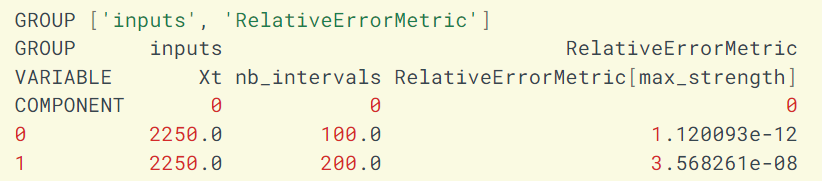
Here, the relative error is found to be negligible.
Matrix
| Unnamed: 1 | Unnamed: 2 | Unnamed: 3 | Unnamed: 4 |
|---|---|---|---|
| OpfmPlate | OpfmUnitCell | OpfmCube | rel_tol |
| PST, [0] | PST0 | PST0 | 0.2 |
| PST, [0, 0] | PST0 | PST0 | 0.2 |
| PST, [90] | PST90 | PST90 | 0.2 |
| PST, [90, 90] | PST90 | PST90 | 0.2 |
| PSC, [0] | PSC0 | PSC0 | 0.2 |
| PSC, [0, 0] | PSC0 | PSC0 | 0.2 |
| PSC, [90] | PSC90 | PSC90 | 0.2 |
| PSC, [90, 90] | PSC90 | PSC90 | 0.2 |
| PST, [45, -45]s | IPS | IPS | 0.2 |
| nan | nan | nan | nan |
| nan | nan | nan | nan |
| PgPlate | nan | nan | nan |
| OHT | VATool | nan | 0.2 |
| PST | VATool | nan | 0.2 |
| nan | nan | nan | nan |
| nan | nan | nan | nan |
| nan | nan | nan | nan |
| OpfmCube | nan | nan | nan |
| PST0 | max_strength=Xt | nan | epsilon |
| PSC0 | max_strength=Xc | nan | epsilon |
| PST90 | max_strength=Yt | nan | epsilon |
| PSC90 | max_strength=Yc | nan | epsilon |
Verification of the integration of the Opfm material law with Abaqus
Repeat above verif for OpfmCUbe
Then, the integration of the Opfm law with Abaqus, which is done through VIMSEO
RunAbaqusWrapper can be performed.
First, we can check that the OpfmCube and OpfmUnitCell models return results that are close
on load cases with uniform stress distribution.
By close, we mean \(10 \%\) error, because the boundary conditions between the two
models are not strictly the same.
TODO add link to deployed doc
Code verification for OpfmPlate model PST
Secondly, we can check that the OpfmPlate and OpfmCube model also return close results.
The following test matrix is used:
| OpfmPlate | layup | OpfmUnitCell | OpfmCube | rel_tol |
|---|---|---|---|---|
| PST | [0] | PST0 | PST0 | 0.1 |
| PST | [0, 0] | PST0 | PST0 | 0.1 |
| PST | [90] | PST90 | PST90 | 0.1 |
| PST | [90, 90] | PST90 | PST90 | 0.1 |
| PSC | [0] | PSC0 | PSC0 | 0.1 |
| PSC | [0, 0] | PSC0 | PSC0 | 0.1 |
| PSC | [90] | PSC90 | PSC90 | 0.1 |
| PSC | [90, 90] | PSC90 | PSC90 | 0.1 |
The OpfmPlate PST model is verified against OpfmCube PST.
The variables of the parameter space on which the models are sampled
correspond to input variables to which the max_strength output
is the most sensitive for the OpfmCube PST model, which are:
- \(E1\)
- \(E1t\)
- \(G12\)
- \(Xt\)
The geometrical parameters:
- \(width\)
- \(length\)
- \(thickness\)
are also added. Triangular distributions are defined for each variable,
ranging over the bounds defined in the Opfm material of vims-composites.
TODO link to example
Layup \([0]\)
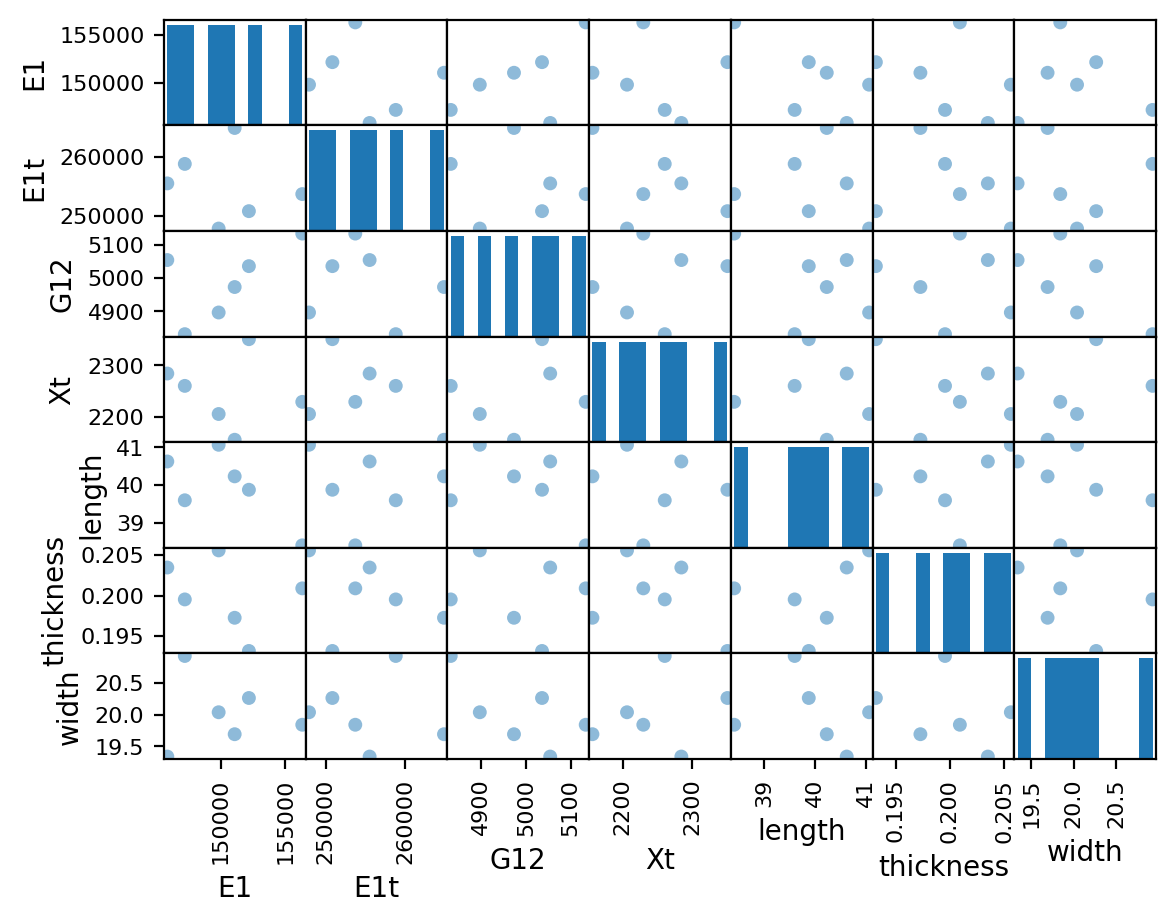
The input parameter space is represented in the following figure:
One way to represent how the error range and their distribution
is to plot a histogram of the errors (one for each error metric).
Thus, in abscissa we have error band values, and in ordinate
we have the number of error values within a given band.
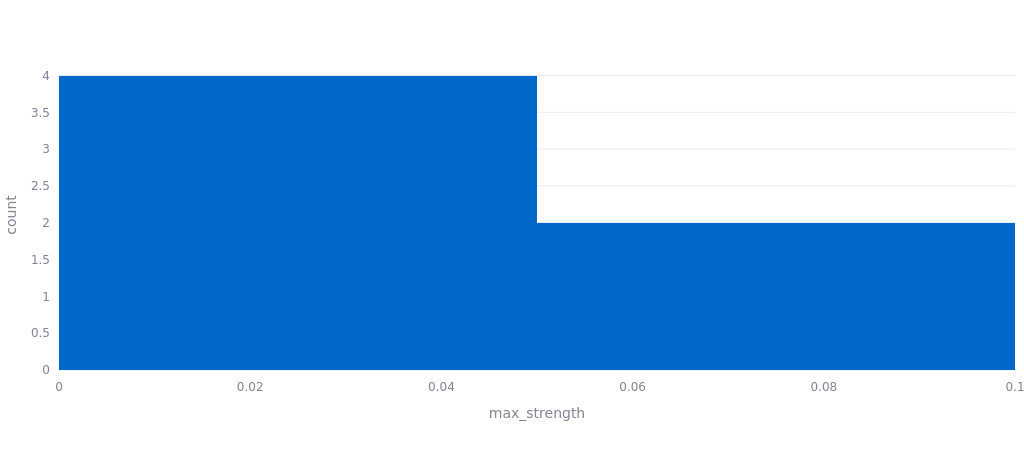
We observe that the relative error on \(max\_strength\) between the two models
can reach \(10 \%\):